


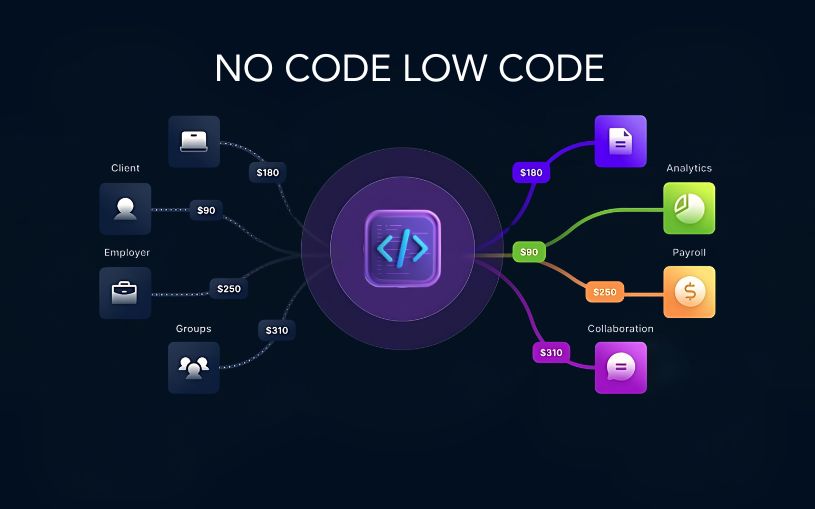

The demand for digital solutions has grown rapidly in recent years, pushing businesses to develop applications faster than ever before. However, the shortage of skilled software developers and the increasing complexity of traditional programming have created significant challenges. To overcome these obstacles, organizations are increasingly adopting low-code and no-code development platforms.
These platforms enable users to build websites, mobile applications, business workflows, and automation tools with minimal or no programming knowledge. By simplifying the development process, low-code and no-code platforms are transforming how businesses innovate, reduce costs, and accelerate digital transformation.
What Are Low-Code and No-Code Development Platforms?
Low-code and no-code platforms are software development environments that allow users to create applications using visual interfaces instead of writing extensive code.
Low-code platforms require some programming knowledge and allow developers to customize applications by adding code when necessary. They are ideal for building complex business applications while reducing development time.
No-code platforms are designed for users with little or no technical background. They use drag-and-drop interfaces, pre-built templates, and visual workflows to help users create applications without writing code.
Both approaches aim to simplify software development while making technology accessible to a wider audience.
Why Low-Code and No-Code Platforms Are Growing
Businesses are under constant pressure to deliver digital services quickly while keeping development costs under control. Traditional software development often requires large teams, lengthy development cycles, and significant financial investment.
Low-code and no-code platforms solve these challenges by enabling faster application development and allowing non-technical employees to participate in creating business solutions.
As organizations embrace digital transformation, these platforms have become valuable tools for increasing productivity and innovation.
Key Features of Low-Code and No-Code Platforms
Modern development platforms offer a variety of features that simplify application creation.
Visual Development Interface
Instead of manually writing code, users can design applications using drag-and-drop components. This approach significantly reduces development complexity while making software creation more accessible.
Pre-Built Templates
Most platforms provide ready-made templates for websites, mobile applications, customer management systems, and business workflows. These templates help users launch projects quickly while maintaining professional design standards.
Workflow Automation
Users can automate repetitive business processes such as approvals, notifications, document management, and customer communications without extensive programming knowledge.
Cloud-Based Development
Many platforms operate in the cloud, allowing teams to collaborate remotely while accessing applications from anywhere with an internet connection.
Benefits for Businesses
Low-code and no-code platforms provide numerous advantages for organizations across different industries.
Faster Development
Applications that previously required months of development can often be completed in weeks or even days. This faster development cycle helps businesses respond quickly to changing market demands.
Reduced Development Costs
Organizations can lower software development expenses by reducing reliance on large development teams. Business users can create many internal applications independently, minimizing outsourcing costs.
Increased Productivity
Employees can automate routine tasks and build custom solutions that improve daily operations. This allows IT departments to focus on more complex technical projects.
Improved Collaboration
Business teams and software developers can work together more effectively. Non-technical staff can contribute directly to application design, reducing communication gaps and improving project outcomes.
Common Business Applications
Low-code and no-code platforms support a wide variety of business use cases.
Companies use these platforms to develop customer relationship management (CRM) systems, inventory management applications, employee onboarding portals, project management tools, customer service platforms, and internal dashboards.
Many organizations also build mobile applications, online forms, approval workflows, appointment scheduling systems, and e-commerce websites using these technologies.
Their flexibility makes them suitable for businesses of all sizes.
Impact on Professional Developers
Some people believe low-code and no-code platforms will replace software developers. In reality, these platforms are changing the role of developers rather than eliminating it.
Professional developers continue to play an essential role in designing complex systems, integrating applications, ensuring security, optimizing performance, and developing advanced custom features.
Instead of spending time on repetitive coding tasks, developers can focus on solving complex technical problems and building scalable enterprise solutions.
Challenges and Limitations
Despite their many advantages, low-code and no-code platforms have certain limitations.
Customization options may be restricted compared to traditional software development. Businesses with highly specialized requirements may still need custom programming.
Performance can become an issue for large-scale enterprise applications with millions of users or highly complex workflows.
Vendor dependency is another concern. Organizations may find it difficult to migrate applications if they become dependent on a specific platform.
Security and compliance should also be carefully evaluated, particularly when handling sensitive customer or financial data.
Industries Adopting Low-Code and No-Code Solutions
Many industries are benefiting from these development platforms.
Healthcare organizations use them to streamline patient management and appointment scheduling. Financial institutions automate internal workflows and customer onboarding processes. Retail businesses develop inventory systems and customer engagement applications.
Educational institutions create online learning portals and administrative systems, while manufacturing companies automate production workflows and equipment monitoring.
Government agencies are also adopting low-code platforms to improve public services and digitize administrative processes.
The Future of Low-Code and No-Code Development
The future of low-code and no-code development looks highly promising. Artificial Intelligence is expected to make these platforms even more powerful by automatically generating application components, recommending workflows, and identifying potential errors during development.
Integration with cloud computing, machine learning, and robotic process automation (RPA) will further expand their capabilities.
Businesses will increasingly use these platforms to accelerate innovation, improve operational efficiency, and respond more quickly to changing customer expectations.
Rather than replacing traditional software development, low-code and no-code platforms will complement it by making application development faster, more collaborative, and accessible to a broader range of users.
Conclusion
Low-code and no-code development platforms are reshaping the software industry by simplifying application development and reducing technical barriers. They empower businesses to build digital solutions faster, lower development costs, and encourage innovation across departments.
Although these platforms have limitations regarding customization and scalability, they offer significant advantages for many business applications. As Artificial Intelligence and cloud technologies continue to evolve, low-code and no-code development will become an even more important part of digital transformation strategies.
Organizations that embrace these platforms will be better positioned to innovate, improve efficiency, and remain competitive in an increasingly digital world.
Frequently Asked Questions (FAQs)
1. What is a low-code development platform?
A low-code development platform allows users to build applications using visual tools while requiring only a small amount of programming for advanced customization.
2. What is a no-code development platform?
A no-code platform enables users to create applications through drag-and-drop interfaces and pre-built components without writing any code.
3. What is the difference between low-code and no-code?
Low-code platforms require some programming knowledge for customization, while no-code platforms are designed for users with little or no coding experience.
4. What are the benefits of low-code and no-code platforms?
These platforms offer faster application development, lower costs, increased productivity, improved collaboration, and easier digital transformation.
5. Can low-code platforms replace software developers?
No. They simplify routine development tasks but still require professional developers for complex applications, integrations, security, and advanced customization.
6. Which industries use low-code and no-code platforms?
Healthcare, finance, retail, education, manufacturing, government, logistics, and many other industries use these platforms to automate processes and build business applications.
7. Are low-code and no-code platforms secure?
Most modern platforms provide strong security features, but organizations must evaluate compliance, data protection, user access controls, and vendor security before deployment.
8. What is the future of low-code and no-code development?
The future includes greater AI integration, smarter automation, cloud-native development, improved scalability, and wider adoption across businesses seeking faster and more cost-effective software development.