


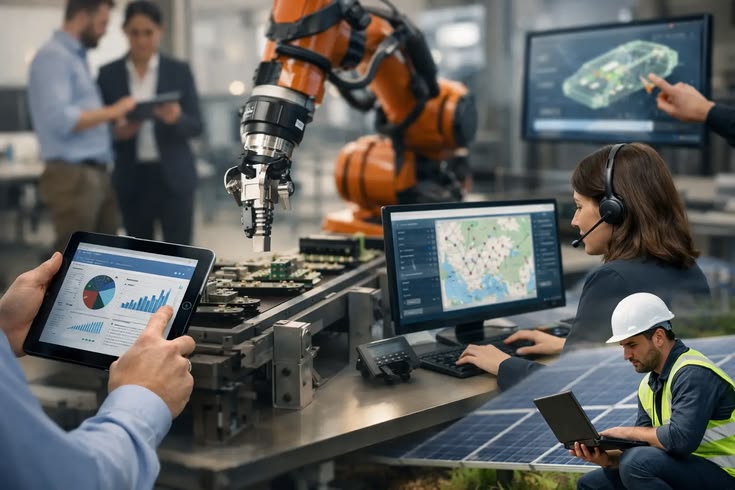

Robotics has become one of the most important technologies shaping modern manufacturing. Once associated mainly with large automotive plants, industrial robots are now used across electronics, food processing, pharmaceuticals, aerospace, metalworking, plastics, logistics and consumer-goods production.
Manufacturers use robots to weld components, assemble products, inspect quality, operate machinery, move materials, package goods and complete many other repetitive processes. Improvements in software, sensors, machine vision and collaborative robotics have also made automation more practical for small and medium-sized manufacturers.
The scale of adoption demonstrates the growing role of this technology. According to the International Federation of Robotics, approximately 542,000 industrial robots were installed worldwide during 2024, while the global operational stock reached about 4.66 million units.
What Are Industrial Robots?
Industrial robots are programmable mechanical systems designed to move materials, tools, parts or specialised devices through controlled motions. They can be programmed to perform various manufacturing activities, including welding, painting, assembly, material handling and machine loading.
A typical robotic manufacturing system may include a robotic arm, controller, sensors, safety equipment and an end effector. The end effector is the device attached to the end of the robotic arm, such as a gripper, welding torch, drill, suction tool or spray gun.
Unlike fixed machinery designed for only one operation, many robots can be reprogrammed and equipped with different tools. This flexibility allows manufacturers to use the same robotic platform for multiple products or production stages.
Increasing Production Speed
One of the main benefits of robotics is faster and more consistent production.
Robots can perform repetitive tasks without experiencing physical fatigue. When properly programmed and maintained, they can complete the same movement continuously while maintaining a stable cycle time.
For example, a robot can repeatedly transfer components from a conveyor to a machine, load raw materials, assemble parts and move finished products to the next workstation. Automating these processes reduces delays between production stages and increases overall throughput.
Robots can also support extended production schedules. Some automated operations can continue during nights, weekends or periods when fewer employees are present, provided suitable supervision, maintenance and safety systems are in place.
NIST identifies improved productivity, increased production capacity and higher throughput as major benefits of robotics and manufacturing automation.
Improving Product Quality and Consistency
Manufacturing quality often depends on maintaining precise measurements, movements, pressure, speed and timing. Small variations can lead to defective products, material waste or expensive rework.
Robots follow programmed instructions with high repeatability. A welding robot, for instance, can maintain a consistent path, angle and operating speed across hundreds of components. A robotic painting system can apply coatings more evenly while reducing overspray.
Manufacturers also combine robotics with machine-vision systems. Cameras and sensors can guide robotic movements and inspect products for defects such as cracks, incorrect dimensions, damaged surfaces, missing parts, unreadable labels or poor seals.
By reducing variation in suitable production processes, robotics can improve product consistency, increase yield and reduce the number of rejected items.
Creating Safer Workplaces
Many manufacturing jobs involve heavy lifting, extreme temperatures, sharp equipment, hazardous chemicals or highly repetitive movements. Robots can perform some of these tasks while reducing direct worker exposure.
Common examples include handling hot metal, spraying industrial coatings, lifting heavy components, operating cutting machinery and working close to hazardous production equipment.
OSHA notes that industrial robots are commonly used for unsafe, hazardous, repetitive or unpleasant activities, including welding, spraying, assembly, machine loading and material handling.
However, introducing robots does not automatically make a workplace safe. Robotic systems create their own risks, particularly during programming, setup, maintenance, testing and repair. Workers may enter the robot’s operating area during these non-routine activities, where unexpected movement can cause serious injuries.
Manufacturers must therefore use appropriate guarding, emergency-stop systems, access controls, worker training and task-based risk assessments.
Supporting Employees with Collaborative Robots
Collaborative robots, commonly called cobots, are designed for applications where robots and people work more closely together.
A cobot may hold a heavy component while an employee completes a detailed assembly task. It may present tools, lift boxes, load a machine or perform repetitive movements while the employee handles inspection, adjustment and decision-making.
This approach allows manufacturers to automate selected parts of a job without fully replacing the human role. Employees continue to contribute judgement, adaptability and problem-solving, while the cobot provides strength, precision and repeatability.
Cobots can be particularly valuable for small manufacturers because they are often more compact and easier to reconfigure than traditional robotic production cells. Nevertheless, every collaborative application still requires a proper safety assessment.
Transforming Material Handling
Moving materials between storage areas, production lines and packaging stations consumes significant time and labour in many factories.
Robotic arms can load and unload machines, arrange components, stack boxes and place products on pallets. Automated guided vehicles and autonomous mobile robots can transport materials between different areas of a facility.
Mobile robots can often follow adjustable routes instead of relying on a permanently installed conveyor. When connected to warehouse or production-management software, they can receive tasks based on inventory levels and production requirements.
Automated material handling can reduce unnecessary walking, manual lifting and waiting time. It can also improve the traceability of materials as they move through the factory.
Enabling Flexible Manufacturing
Modern customers increasingly expect customised products, shorter delivery times and frequent product updates. Manufacturers must therefore produce a wider variety of goods without creating excessive downtime.
Modern robots can be reprogrammed to handle different product models, sizes and production quantities. Adjustable grippers and machine-vision systems allow them to recognise and manipulate various components.
For example, an electronics manufacturer may reprogram an assembly robot when introducing a new device model. A metalworking company may use the same robotic arm to handle different components by changing its tool and operating program.
This flexibility allows manufacturers to produce smaller batches and respond more quickly to changes in customer demand.
Supporting Predictive Maintenance
Unexpected equipment breakdowns can stop production, delay customer orders and generate substantial repair costs.
Modern robots produce operating data related to motor temperature, vibration, movement, cycle time, energy consumption, payload and error conditions. Manufacturers can analyse this information to identify signs of wear or unusual performance.
Instead of waiting for equipment to fail, maintenance teams can inspect components when data indicates that a problem may be developing. This approach is known as predictive maintenance.
Predictive maintenance can reduce unplanned downtime and help companies avoid replacing components unnecessarily. It can also improve maintenance scheduling by allowing repairs to be completed during planned production stops.
Combining Robotics with Artificial Intelligence
Artificial intelligence is expanding what manufacturing robots can accomplish.
Traditional robots usually follow fixed instructions and repeat predetermined movements. AI-supported systems can analyse camera images, recognise objects, identify patterns and make limited adjustments based on changing conditions.
In quality inspection, artificial intelligence can help identify scratches, cracks, missing components and assembly errors. In material handling, it can help robots recognise objects that appear in different positions or orientations.
AI can also support predictive maintenance, production planning and process optimisation. Emerging physical AI systems combine intelligent software with sensors and robotic hardware, allowing machines to interact more effectively with complex physical environments.
However, AI-supported robots require reliable data, careful testing and human oversight. Incorrect training data, sensor failures or software errors may produce inaccurate or unsafe results.
Collecting Data for Better Decisions
Connected robotic systems do more than complete physical tasks. They also generate valuable operational information.
Manufacturers can track production output, robot utilisation, error rates, cycle times, equipment downtime and quality results. Managers can use this data to identify bottlenecks and improve workflows.
For example, frequent pauses in a robotic workstation may indicate that materials are arriving late from another process. The robot itself may be functioning correctly, while the surrounding workflow causes the delay.
NIST identifies operational data collection and improved process understanding as important benefits of manufacturing automation.
When robot data is combined with inventory, maintenance and production systems, manufacturers can make better decisions about scheduling, staffing and equipment investment.
Reducing Waste
Robotic systems can help manufacturers use raw materials more accurately.
Automated cutting, welding, painting and dispensing systems can control the amount of material used during each cycle. Greater consistency may also reduce the number of defective products that must be discarded or manufactured again.
Robots can support sustainability in other ways, such as sorting recyclable materials, disassembling products and handling substances that may be unsafe for employees.
However, robotics is not automatically environmentally friendly. Robots consume electricity and require electronic components, batteries, maintenance and eventual replacement. Their environmental benefits depend on how effectively they reduce waste, energy consumption and production errors.
Making Robotics Accessible to Smaller Manufacturers
Industrial robotics was traditionally considered too expensive and complicated for smaller companies. Advances in sensors, programming tools, machine vision and compact robotic systems are gradually lowering these barriers.
NIST reports that these technological improvements are making robotics increasingly accessible to small manufacturers.
A small company does not need to automate its entire facility at once. It can begin with one stable and repetitive process, such as:
- Machine loading
- Product inspection
- Packaging
- Palletising
Starting with a focused application allows the company to measure productivity, quality, safety and financial performance before expanding automation into other areas.
Changing Manufacturing Jobs
Robotics is changing both the number and nature of manufacturing tasks.
Some repetitive manual activities may require fewer workers after automation. At the same time, manufacturers need employees who can operate, program, maintain and troubleshoot robotic systems.
Demand may increase for automation technicians, engineers, system integrators, maintenance specialists, data analysts and quality-control professionals.
Employees may also move from repetitive physical work into responsibilities involving supervision, inspection, process improvement and decision-making.
The employment impact depends largely on how companies manage the transition. Manufacturers that invest in training can help existing employees develop the technical skills required for automated production environments.
Challenges of Robotic Automation
Although robotics can provide substantial advantages, implementation is not always simple.
The total cost may include the robot, end effectors, sensors, safety guarding, programming, system integration, maintenance, employee training and changes to the production area.
Older machines may not communicate easily with modern robotic systems. Manufacturers may need additional controllers, sensors or software to connect new equipment with existing production lines.
Cybersecurity is another concern. Connected robots may become vulnerable when companies use outdated software, weak passwords or poorly protected remote-access systems.
Manufacturers must also calculate whether the expected improvements justify the investment. Automating an unstable or poorly designed process may create additional problems rather than solve them.
How to Introduce Robotics Successfully
A successful robotics project begins with a clearly defined operational problem.
Manufacturers should examine the existing process and identify tasks that are repetitive, dangerous, physically demanding or difficult to perform consistently. They should then evaluate the expected effect on productivity, quality, safety, staffing and operating costs.
The selected process should normally be stable and measurable. Automating a process that changes constantly or contains unresolved problems may increase complexity.
Manufacturers must also involve employees, safety specialists, equipment suppliers and system integrators during planning. After installation, performance should be measured against clear objectives.
The Future of Robotics in Manufacturing
Manufacturing robots are expected to become more intelligent, mobile, flexible and easier to program.
Artificial intelligence, machine vision, digital twins and advanced sensors will allow robotic systems to operate in more complex production environments. Autonomous mobile robots will play a larger role in factory logistics, while cobots will support workers in assembly, packaging and inspection.
Humanoid robots are also being explored for industrial applications, although many systems remain at an early stage of commercial development. For most manufacturers, specialised industrial robots and cobots currently provide more practical solutions.
Global industrial robot adoption is expected to continue growing. The International Federation of Robotics projected installations to reach approximately 575,000 units in 2025 and pass 700,000 annually by 2028, although actual results will depend on economic conditions and manufacturing investment.
Frequently Asked Questions
What is robotics in manufacturing?
Robotics in manufacturing refers to using programmable machines to perform activities such as welding, assembly, painting, inspection, packaging and material handling.
How are robots transforming manufacturing?
Robots are improving production speed, product consistency, workplace safety, material handling, quality inspection and access to operational data.
Which industries use manufacturing robots?
Robots are used in automotive, electronics, aerospace, food processing, pharmaceuticals, metalworking, plastics, textiles, logistics and consumer-goods manufacturing.
What is the difference between a robot and a cobot?
A conventional industrial robot usually operates in a guarded area. A cobot is designed for applications involving closer interaction with employees, although safety controls are still required.
Do robots replace factory workers?
Robots may reduce some repetitive roles, but they also create demand for programmers, technicians, operators, maintenance specialists and automation engineers. Many systems are designed to support employees rather than replace them completely.
How do robots improve product quality?
Robots repeat programmed movements consistently and can precisely control position, speed, pressure and timing. They can also use cameras and sensors to identify manufacturing defects.
Are manufacturing robots safe?
Robots can reduce exposure to dangerous tasks, but poorly designed or maintained systems can create hazards. Proper guarding, risk assessments, training and emergency controls are essential.
Can small manufacturers use robotics?
Yes. Smaller companies can begin with compact robots or cobots for specific processes such as packaging, palletising, machine loading or inspection.
What are the disadvantages of manufacturing robots?
Potential disadvantages include high initial costs, integration difficulties, maintenance needs, cybersecurity risks and employee-training requirements.
How does artificial intelligence improve robots?
AI helps robots analyse images, recognise objects, detect defects, predict maintenance needs and adjust certain actions according to changing conditions.
What tasks are best suited to robotics?
Tasks that are repetitive, hazardous, physically demanding, measurable or dependent on high precision are often suitable for robotic automation.
Will all factories become fully automated?
Complete automation is unlikely to be suitable for every factory. Many manufacturers will use a combination of robots, conventional machinery and skilled human workers.
Conclusion
Robotics is transforming manufacturing by increasing productivity, improving quality and reducing employee exposure to dangerous or repetitive tasks. It is also helping companies collect operational data, improve maintenance, manage materials and respond more quickly to customer demand.
Advances in collaborative robots, artificial intelligence, sensors and machine vision are making automation more flexible and accessible. However, successful implementation requires careful process selection, employee training, strong safety controls and realistic financial planning.
The future of manufacturing is not simply about replacing people with machines. It is about combining human judgement and technical expertise with the speed, precision and consistency of robotic systems.