


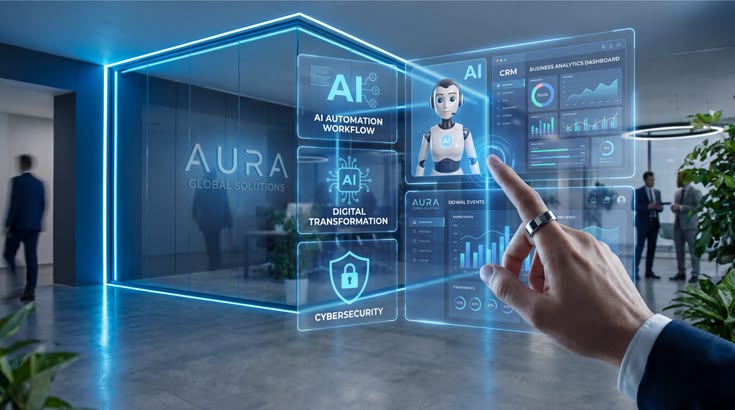

Business automation has become a key driver of digital transformation across industries. Organizations are increasingly using intelligent systems to automate repetitive tasks, improve productivity, reduce operational costs, and enhance customer experiences. Advances in artificial intelligence (AI), machine learning, robotic process automation (RPA), and cloud computing are enabling businesses to work smarter and respond more quickly to changing market demands.
As these technologies continue to evolve, intelligent automation is expected to play an even greater role in shaping the future of work. Companies that adopt automation strategically can improve efficiency while allowing employees to focus on creativity, innovation, and high-value decision-making.
What Is Business Automation?
Business automation is the use of technology to perform tasks with minimal human intervention.
Automation can handle routine processes such as data entry, invoice processing, customer support, inventory management, scheduling, and reporting. By reducing manual work, businesses can improve accuracy, save time, and increase overall productivity.
Modern automation often combines software, artificial intelligence, and analytics to optimize complex business operations.
Understanding Intelligent Systems
Intelligent systems are technologies that can analyze data, learn from experience, and make decisions or recommendations.
These systems may include:
- Artificial intelligence
- Machine learning
- Robotic process automation (RPA)
- Natural language processing (NLP)
- Computer vision
- Intelligent chatbots
Together, these technologies help organizations automate increasingly sophisticated tasks.
The Evolution of Business Automation
Automation has evolved significantly over the years.
Traditional automation focused on simple rule-based processes. Today’s intelligent systems can analyze large datasets, recognize patterns, predict outcomes, and continuously improve through machine learning.
This shift enables businesses to automate not only repetitive tasks but also more complex decision-making processes.
Artificial Intelligence in Automation
Artificial intelligence is at the heart of many modern automation systems.
AI enables businesses to:
- Predict customer behavior
- Personalize marketing campaigns
- Detect fraud
- Improve demand forecasting
- Analyze business performance
- Support faster decision-making
AI-driven automation helps organizations operate more efficiently while improving customer satisfaction.
Robotic Process Automation (RPA)
RPA uses software robots to perform repetitive digital tasks.
Examples include:
- Processing invoices
- Updating databases
- Generating reports
- Managing employee records
- Handling routine customer requests
RPA reduces human error and allows employees to concentrate on strategic responsibilities.
Cloud Computing Supports Automation
Cloud platforms provide the infrastructure needed for scalable automation.
Businesses can deploy intelligent applications, access computing resources on demand, and integrate automation across multiple locations without investing heavily in physical hardware.
Cloud technology also supports remote work and global collaboration.
Data Analytics and Smarter Decisions
Automation becomes more valuable when combined with data analytics.
Organizations collect and analyze large amounts of information to identify trends, measure performance, and optimize business processes. Real-time insights help leaders make informed decisions and respond quickly to market changes.
Data-driven automation improves both efficiency and competitiveness.
Intelligent Customer Service
Customer service is being transformed through intelligent automation.
Businesses use AI-powered chatbots, virtual assistants, and automated ticketing systems to answer common questions, resolve routine issues, and provide support around the clock.
Human agents remain essential for handling complex or sensitive customer interactions.
Automation in Supply Chain Management
Supply chains are becoming increasingly automated.
Businesses use intelligent systems to:
- Forecast demand
- Track inventory
- Optimize delivery routes
- Monitor shipments
- Reduce operational delays
- Improve warehouse efficiency
Automation helps organizations build more resilient and responsive supply chains.
Human and Machine Collaboration
Automation is not intended to replace every human role.
Instead, many businesses use intelligent systems to support employees by handling repetitive work while people focus on creativity, critical thinking, leadership, and relationship building.
Successful organizations combine human expertise with technological capabilities.
Challenges of Intelligent Automation
Despite its benefits, automation presents several challenges.
These include:
- High implementation costs
- Cybersecurity risks
- Data privacy concerns
- Employee training requirements
- Integration with legacy systems
- Ethical considerations surrounding AI
Careful planning and governance are essential for successful automation projects.
Skills Needed for the Future
As automation expands, employees will need new skills to work alongside intelligent systems.
Important skills include:
- Digital literacy
- Data analysis
- Critical thinking
- Problem-solving
- AI awareness
- Adaptability
Continuous learning will become increasingly important in the modern workplace.
The Future of Intelligent Business Systems
The future of automation will include more advanced AI, autonomous decision support, predictive analytics, edge computing, Internet of Things (IoT) integration, and collaborative robots. Businesses are also expected to adopt hyperautomation, which combines multiple automation technologies to streamline entire organizational workflows.
These innovations will create more agile, efficient, and customer-focused organizations.
Conclusion
Business automation and intelligent systems are reshaping how organizations operate in the digital economy. By combining artificial intelligence, robotic process automation, cloud computing, and advanced analytics, businesses can improve productivity, reduce costs, and deliver better customer experiences.
While automation introduces challenges such as cybersecurity, workforce adaptation, and ethical considerations, organizations that invest in responsible implementation and continuous employee development will be better positioned for long-term success. The future belongs to businesses that effectively balance technological innovation with human expertise.
Frequently Asked Questions (FAQs)
1. What is business automation?
Business automation is the use of technology to perform repetitive or routine tasks with minimal human intervention, improving efficiency and accuracy.
2. What are intelligent systems?
Intelligent systems are technologies such as AI, machine learning, robotic process automation, and natural language processing that can analyze data, learn, and support decision-making.
3. How does AI improve business automation?
AI helps automate complex processes, analyze large datasets, personalize customer experiences, predict trends, detect fraud, and support faster business decisions.
4. What is Robotic Process Automation (RPA)?
RPA uses software robots to automate repetitive digital tasks such as data entry, invoice processing, report generation, and record management.
5. Will automation replace human workers?
Automation is more likely to change job roles than replace all workers. It typically handles repetitive tasks while allowing employees to focus on creative, strategic, and customer-focused responsibilities.
6. What industries benefit from business automation?
Automation is widely used in finance, healthcare, manufacturing, retail, logistics, education, customer service, marketing, and many other industries to improve efficiency and productivity.