


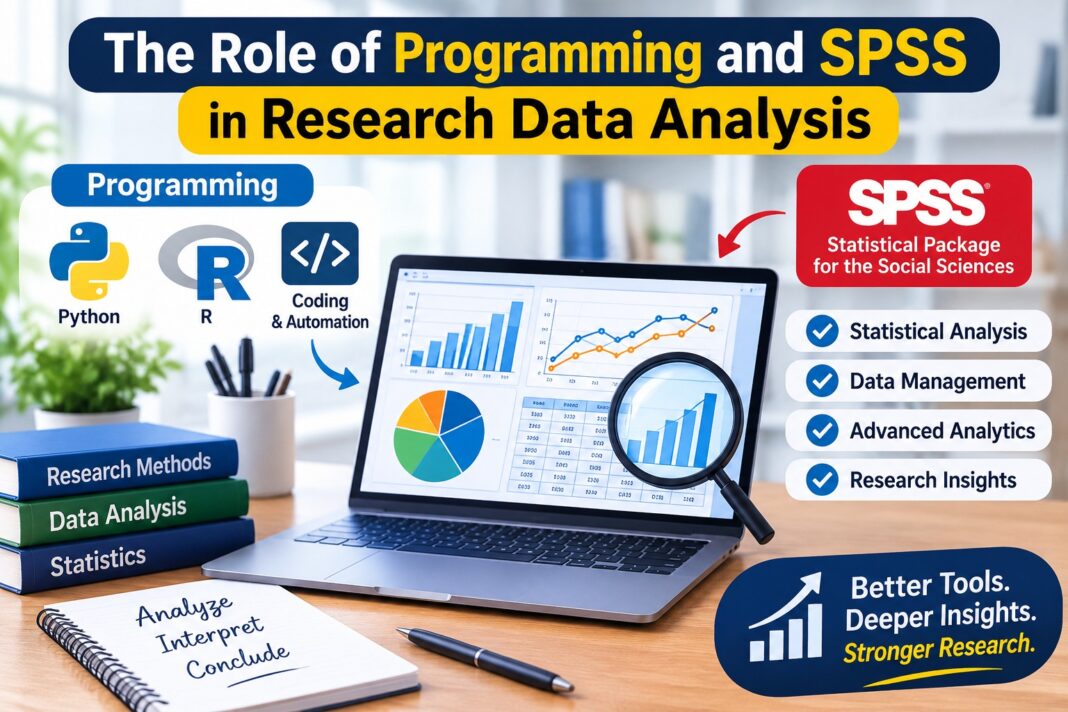

Research data analysis helps students organise information, identify patterns, test hypotheses, and draw evidence-based conclusions. Programming languages and statistical software play an important role in this process. While programming provides flexibility for handling complex datasets, SPSS offers accessible tools for performing statistical tests and analysing research findings.
Understanding these tools can help students improve their analytical skills and produce more reliable academic research. Students exploring an online assignment writing service may also benefit from developing their knowledge of research methods and data analysis.
1. Understand the Purpose of Research Data Analysis
Research data analysis involves examining collected information to answer research questions and evaluate hypotheses. The approach depends on the research objectives, data type, and methodology.
For example, a student investigating whether revision time affects examination performance might analyse study hours and examination scores to identify possible relationships. Before choosing a tool, students should understand their research questions, identify relevant variables, and select suitable analytical methods.
2. Explore the Role of Programming in Data Analysis
Programming languages such as Python and R help researchers process datasets, automate repetitive tasks, and perform statistical calculations. They are particularly useful when research involves large datasets or customised analytical procedures.
Programming supports several research activities, including:
- Cleaning and organising raw data.
- Automating repetitive calculations.
- Identifying patterns and relationships between variables.
- Creating charts and visualisations.
- Repeating analytical procedures using documented code.
3. Understand How SPSS Supports Statistical Analysis
SPSS is statistical software widely used in academic, business, and social science research. Its graphical interface allows users to perform many statistical tests without writing extensive code.
Researchers can use SPSS to calculate descriptive statistics, conduct correlation and regression analyses, compare groups, and examine survey responses.
For example, a student studying student satisfaction could use SPSS to summarise questionnaire results and investigate differences between groups. However, students must still select appropriate tests, check assumptions, and interpret results accurately.
4. Compare Programming and SPSS
Programming and SPSS offer different advantages depending on research requirements. SPSS is often convenient for users who prefer a graphical interface, whereas programming provides greater flexibility for customised workflows. Both tools support statistical analysis and reproducibility when researchers document their procedures carefully.
5. Prepare and Clean Research Data
Data preparation is essential because incorrect entries, duplicate records, and missing values can affect research findings. Before performing statistical tests, students should check their datasets for errors and ensure variables are coded consistently.
Important preparation tasks include checking missing values and duplicate records, investigating unusual observations, applying consistent variable formats, and confirming that the data match the research objectives. Both programming and SPSS can support these tasks. Researchers should document changes made to their datasets to maintain transparency.
6. Select Appropriate Statistical Methods
Choosing the correct statistical method helps researchers produce meaningful findings. The decision depends on the research question, measurement scales, study design, and assumptions of the selected test.
Descriptive statistics summarise data, correlation examines associations between variables, and regression investigates how an outcome relates to one or more explanatory variables. Students should understand what each method measures rather than selecting a test simply because it is available in their software. Those developing their coding skills through a Programming Assignment Writing Service UK can also focus on programming logic, data handling, and analytical techniques.
7. Interpret and Present Research Findings
Generating statistical output is only one part of research. Students must explain what the results mean in relation to their research questions and supporting evidence. Tables and charts can make findings easier to understand, but written explanations should highlight important patterns and acknowledge limitations.
Students should report statistical values accurately, distinguish statistical significance from practical importance, explain relevant relationships, and ensure conclusions are supported by evidence. Students looking to write my SPSS assignment can practise interpreting statistical outputs and explaining analytical procedures in their own words.
8. Avoid Common Data Analysis Mistakes
Common mistakes include selecting unsuitable statistical tests, overlooking missing data, misinterpreting p-values, and assuming correlation proves causation. Students should avoid relying entirely on automated outputs without understanding the methods and assumptions behind them. Checking data, documenting procedures, reviewing statistical assumptions, and acknowledging limitations can improve analytical accuracy and academic integrity.
Conclusion
Programming and SPSS support research data analysis by helping students organise information, conduct statistical tests, and interpret findings. Programming offers flexibility and automation, while SPSS provides accessible tools for many common statistical procedures.
By preparing data carefully, selecting appropriate methods, and reporting results accurately, students can strengthen their research skills and produce clearer, more reliable academic work.