


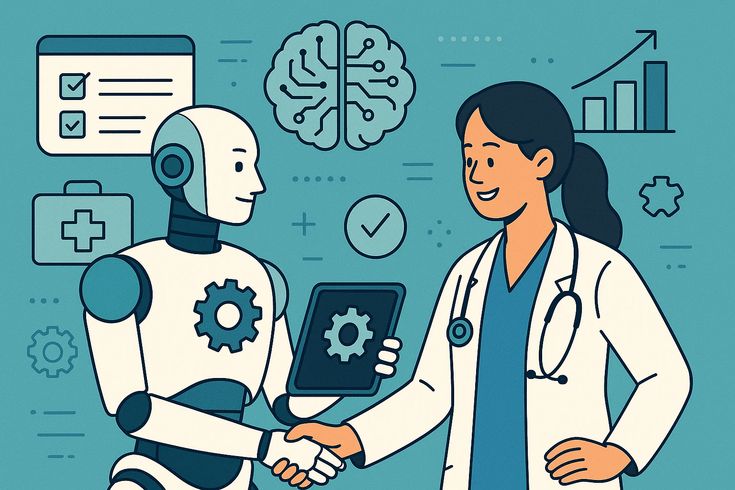
 is rapidly changing the healthcare industry. From improving diagnosis and patient care to automating administrative work, AI is helping healthcare)
Artificial Intelligence (AI) is rapidly changing the healthcare industry. From improving diagnosis and patient care to automating administrative work, AI is helping healthcare businesses become more efficient, accurate, and responsive.
Hospitals, clinics, pharmaceutical companies, insurance providers, and health technology businesses are increasingly using AI to analyze data, support medical professionals, and improve operations. As the technology continues to develop, its influence on healthcare businesses is expected to grow significantly.
What Is AI in Healthcare?
AI in healthcare refers to the use of technologies such as machine learning, natural language processing, computer vision, and predictive analytics to perform or support healthcare-related tasks.
These systems can analyze large amounts of medical and operational data much faster than traditional manual processes. AI can assist healthcare professionals, but important clinical decisions still require appropriate human judgment and oversight.
AI and Medical Diagnosis
One of the most important applications of AI is supporting medical diagnosis. AI systems can analyze medical images and other clinical data to identify patterns that may require further investigation.
In areas such as radiology and pathology, AI can assist professionals by highlighting potential abnormalities and prioritizing cases. This can improve workflow efficiency and help medical teams focus their attention where it is most needed.
Improving Patient Experience
Healthcare businesses are using AI to make patient interactions more convenient.
AI-powered virtual assistants and chatbots can help with appointment scheduling, general information, reminders, and basic administrative questions. Automated systems can also reduce waiting times and make it easier for patients to access services.
Personalization is another important benefit. When used responsibly, data analysis can help healthcare providers deliver more relevant communication and support.
Automating Administrative Tasks
Administrative work represents a significant part of healthcare operations. AI can help automate repetitive tasks such as documentation, appointment management, billing support, and data processing.
Reducing manual workloads allows healthcare employees to spend more time on complex responsibilities and patient-focused activities. Automation can also help reduce certain errors and improve operational consistency.
Predictive Analytics in Healthcare
Predictive analytics uses historical and real-time data to identify trends and estimate possible future outcomes.
Healthcare organizations may use predictive tools to forecast patient demand, manage staffing requirements, improve resource allocation, and identify operational risks. These insights can support better planning and more efficient use of healthcare resources.
AI in Drug Discovery
Developing new medicines is traditionally a long and expensive process. AI is helping pharmaceutical and biotechnology companies analyze large datasets, identify promising research targets, and support the discovery of potential drug candidates.
Although AI does not remove the need for laboratory research and clinical trials, it can help researchers explore possibilities more efficiently.
Personalized Healthcare
AI is contributing to the development of more personalized approaches to healthcare.
By analyzing appropriate medical information, treatment history, and other relevant data, advanced systems may help professionals better understand individual differences between patients. This can support more targeted approaches to treatment and care planning.
Strong privacy protections and professional oversight remain essential when sensitive health information is involved.
AI in Medical Imaging
Computer vision technology has become an important area of healthcare AI.
AI systems can assist in analyzing X-rays, scans, and other medical images. They may help detect patterns, prioritize urgent cases, and support healthcare professionals during the review process.
The most effective approach generally combines technological capabilities with the expertise of qualified medical professionals.
Healthcare Business Operations
AI is not limited to direct patient care. It can also improve the business side of healthcare.
Organizations use AI to support inventory management, workforce planning, supply chain operations, fraud detection, and financial analysis. Better operational efficiency can help healthcare businesses control costs while maintaining service quality.
Benefits of AI for Healthcare Businesses
AI can provide several important advantages, including faster data analysis, improved operational efficiency, better resource planning, and greater automation.
For healthcare businesses, these benefits can lead to more efficient workflows and better use of staff time. However, results depend on the quality of the technology, data, implementation, and human oversight.
Challenges of AI Adoption
Despite its potential, AI presents important challenges for healthcare businesses.
Data Privacy and Security
Healthcare organizations manage highly sensitive information. Strong cybersecurity, access controls, and compliance with applicable privacy requirements are essential.
Accuracy and Reliability
AI systems can make mistakes. Their performance must be carefully tested, monitored, and evaluated before they are used in important healthcare settings.
Bias in AI Systems
Biased or incomplete training data can produce unfair or unreliable results. Healthcare organizations must evaluate systems across relevant populations and use appropriate safeguards.
Integration Costs
Implementing AI may require investment in software, infrastructure, training, and system integration.
Human Oversight
AI should support qualified professionals rather than automatically replace human judgment in high-stakes medical decisions.
The Future of AI in Healthcare Businesses
The future of healthcare AI is likely to include more advanced clinical support tools, improved automation, smarter operational systems, and increasingly personalized services.
AI may also support remote healthcare, medical research, drug development, and more efficient management of hospitals and clinics. As adoption grows, responsible governance will become increasingly important.
Businesses will need to balance innovation with patient safety, privacy, transparency, and regulatory requirements.
How Healthcare Businesses Can Prepare
Healthcare organizations should adopt AI strategically rather than simply following technology trends. They should identify clear problems that AI can help solve, evaluate systems carefully, protect sensitive information, and train employees to use new tools effectively.
Successful adoption depends on combining technology with professional expertise, strong governance, and a clear focus on patient needs.
Conclusion
Artificial Intelligence is transforming healthcare businesses by improving data analysis, supporting medical professionals, automating administrative work, and helping organizations operate more efficiently.
Its greatest value comes from using technology responsibly alongside human expertise. While challenges involving privacy, bias, accuracy, security, and regulation remain, carefully implemented AI has the potential to improve both healthcare delivery and business operations.
As the technology continues to evolve, healthcare organizations that focus on responsible innovation and meaningful outcomes will be better prepared for the future.
Frequently Asked Questions (FAQs)
1. How is AI used in healthcare businesses?
AI is used for medical data analysis, administrative automation, predictive analytics, medical imaging support, patient communication, drug research, and operational planning.
2. Can AI replace doctors and healthcare professionals?
AI is generally most useful as a support tool. Qualified professionals remain essential for clinical judgment, patient communication, and high-stakes medical decisions.
3. How does AI improve healthcare operations?
AI can automate repetitive tasks, analyze large datasets, support workforce planning, improve resource allocation, and streamline administrative processes.
4. What are the main risks of AI in healthcare?
Major concerns include data privacy, cybersecurity, inaccurate results, algorithmic bias, lack of transparency, and overreliance on automated systems.
5. How is AI helping pharmaceutical companies?
AI can support drug discovery by analyzing large datasets, identifying research targets, and helping researchers investigate potential drug candidates more efficiently.
6. What is the future of AI in healthcare?
The future is expected to include more advanced decision-support systems, greater automation, personalized services, improved research tools, and wider integration of AI into healthcare operations.