


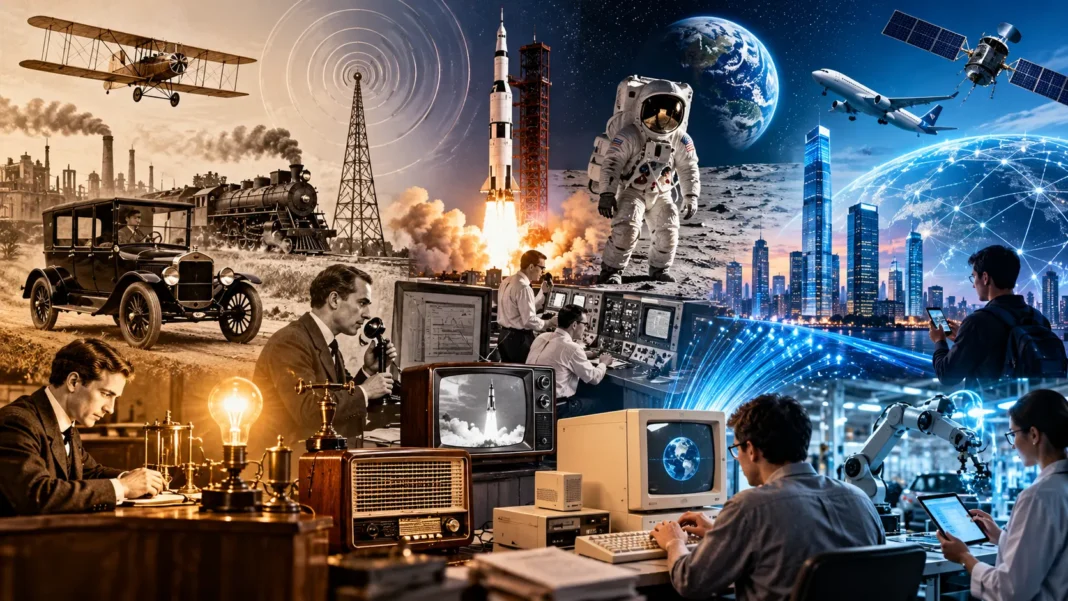

The 20th century was one of the most transformative periods in human history. Within just 100 years, the world moved from horse-drawn transportation and limited electricity to airplanes, computers, satellites, and global communication networks. Scientific discoveries and technological innovations changed how people worked, traveled, communicated, and lived their everyday lives.
But why did technology advance so fast in the 20th century compared with earlier periods? The answer involves several connected factors, including industrialization, scientific research, global conflicts, economic competition, government investment, and improvements in education. These developments created conditions where new inventions could spread and improve much faster than before.
Technological progress was not the result of one extraordinary invention or discovery. Instead, breakthroughs in electricity, transportation, medicine, manufacturing, and computing supported further innovations. Understanding these connections explains how the 20th century became a defining period in the history of modern technology.
The Industrial Revolution Created the Foundation for Faster Innovation
The rapid technological advancement of the 20th century began with foundations established during the Industrial Revolution. Throughout the 18th and 19th centuries, industrial societies developed factories, mechanical production systems, and improved transportation networks. These changes increased manufacturing capacity and encouraged inventors to develop practical solutions. By the early 1900s, many industries already possessed the infrastructure needed for further innovation.
Steam engines, railway systems, and industrial machinery transformed production before the 20th century began. Engineers learned how to design more reliable machines and manufacture standardized components. These improvements made it easier to build complex technologies on a larger scale. Industrial experience also created a growing workforce familiar with mechanical systems, engineering methods, and technical problem-solving.
As industrial economies expanded, companies invested more resources in research and manufacturing improvements. Businesses recognized that better machines could increase production, lower costs, and improve competitiveness. This connection between technological progress and economic opportunity encouraged continued experimentation. The industrial foundations of earlier centuries therefore played an essential role in accelerating innovation during the 1900s.
Electricity Changed How Technology Developed
Electricity was one of the most important forces behind technological progress in the 20th century. Although major electrical discoveries occurred during earlier periods, large-scale electrification expanded significantly during the 1900s. Homes, factories, offices, and transportation systems increasingly relied on electrical power. This dependable energy source created opportunities for entirely new technologies and industries.
Electric motors transformed manufacturing by allowing machines to operate more efficiently and flexibly. Electric lighting extended productive activities beyond daylight hours and improved many working environments. Communication systems also benefited from advances in electrical engineering. Technologies such as radio, television, and early electronic computers depended on the growing understanding and application of electricity.
Electrical infrastructure supported innovation across multiple industries simultaneously. Factories could adopt new equipment, households could use appliances, and researchers could develop increasingly sophisticated instruments. As electricity became more widely available, demand for electrical products encouraged further investment. This created a cycle where improved infrastructure supported inventions that increased the importance of electricity.
Scientific Research Became More Organized and Advanced
Scientific research expanded dramatically during the 20th century as universities, governments, and private organizations increased their investment in discovery. Earlier scientific breakthroughs had often depended on smaller research teams or individual investigators. During the 1900s, larger institutions developed specialized laboratories and coordinated research programs. This organization allowed scientists to investigate increasingly complex problems using advanced equipment.
Important discoveries in physics, chemistry, and biology contributed directly to technological development. Quantum mechanics supported advances in semiconductor science, while nuclear physics opened new possibilities for energy research. Improvements in chemistry enabled the production of synthetic materials and specialized industrial products. These scientific developments helped engineers create technologies that had previously been impossible.
Communication between scientists also became more efficient as academic institutions and professional organizations expanded. Research journals, conferences, and international collaborations helped spread new findings. Scientists could build upon earlier discoveries rather than repeatedly solving the same problems. This accumulation of knowledge accelerated the relationship between scientific understanding and practical technological innovation.
World War I Accelerated Industrial and Military Technology
World War I created enormous pressure for governments and industries to improve military equipment, transportation, and communication systems. Countries invested heavily in engineering and industrial production to support their armed forces. Aircraft, vehicles, radio equipment, and medical technologies received increased attention. The conflict demonstrated how organized research and manufacturing could rapidly develop technologies under urgent conditions.
Aviation advanced significantly as aircraft became increasingly important for reconnaissance and combat operations. Engineers improved engines, aircraft structures, and manufacturing techniques to meet military demands. Communication systems also developed as armies needed faster methods of coordinating activities. These innovations influenced civilian industries after the war, although their wartime development came at enormous human cost.
The conflict also encouraged improvements in industrial organization and large-scale production. Governments coordinated factories, transportation networks, and supply systems to support military operations. Some techniques developed during this period later influenced commercial manufacturing. World War I therefore accelerated certain technologies, even though war also destroyed infrastructure and diverted resources from peaceful development.
World War II Encouraged Major Technological Breakthroughs
World War II was another major turning point in the history of technological advancement. Governments devoted substantial resources to scientific research, engineering, and industrial production. The need for improved communication, transportation, medical treatment, and military capabilities encouraged rapid experimentation. Several technologies that shaped the postwar world developed or advanced significantly during this period.
Radar systems improved the detection of aircraft and ships, while advances in electronics supported increasingly sophisticated communication equipment. Jet engine development transformed the possibilities of aviation. Early electronic computers helped address complex mathematical and operational problems. Wartime programs also expanded nuclear research and accelerated the development and production of important medical treatments.
After the war, many scientific techniques and industrial capabilities became available for civilian applications. Jet aviation eventually transformed international travel, while electronic computing influenced business and research. Medical advances contributed to improved healthcare practices. However, the destruction caused by the conflict highlights an important distinction between technological acceleration and broader human progress.
The Cold War Increased Competition Between Superpowers
The Cold War created intense scientific and technological competition between the United States and the Soviet Union. Both countries viewed technological leadership as essential for national security, economic influence, and international prestige. Governments invested heavily in aerospace engineering, communications, nuclear science, and computing. This competition supported ambitious research programs that influenced technological development worldwide.
The Space Race became one of the most visible examples of Cold War innovation. The Soviet Union launched Sputnik 1 in 1957, demonstrating important advances in rocket and satellite technology. The United States later achieved the first human Moon landing in 1969. These milestones required major improvements in engineering, computing, materials, and communication systems.
Cold War investments also supported technologies beyond space exploration. Research in electronics, navigation, communications, and computer networking contributed to later civilian applications. Universities and private companies often participated in government-funded projects. Although political competition increased technological investment, cooperation among scientists and commercial innovation also played important roles in the development of modern systems.
Mass Production Made New Technology More Affordable
Mass production helped technological innovations reach ordinary consumers much faster during the 20th century. Manufacturing improvements allowed companies to produce large quantities of standardized products more efficiently. Assembly-line techniques became particularly influential in automobile production. As production methods improved, many technologies gradually became more affordable and accessible to wider populations.
Henry Ford’s moving assembly line, introduced for automobile manufacturing in 1913, demonstrated the advantages of organized production. The approach reduced production time and helped lower manufacturing costs. Similar principles influenced industries producing appliances, radios, and other consumer goods. Standardized parts and specialized machinery made it easier to manufacture reliable products consistently.
As more households gained access to modern technologies, consumer demand encouraged further improvements. Companies competed to offer better performance, convenience, and affordability. Increased sales also provided revenue for research and expansion. This relationship between mass production and consumer demand helped technological innovations spread rapidly across industrialized societies.
The Invention of Computers Transformed Technological Progress
Computers became one of the most influential technological developments of the 20th century. Early computing machines were large, expensive, and primarily used by governments, universities, and major organizations. Over time, improvements in electronic components made computers smaller, faster, and more practical. These changes transformed how information could be processed, stored, and analyzed.
The invention of the transistor in 1947 marked a major development in electronics. Transistors gradually replaced vacuum tubes in many applications because they could be smaller and more reliable. Integrated circuits, developed in the late 1950s, allowed multiple electronic components to be placed on a single chip. These advances helped establish the foundations of modern computing.
Personal computers became increasingly accessible during the 1970s and 1980s, expanding computing beyond specialized institutions. Businesses adopted digital systems for accounting, communication, and data management. Researchers used computers to analyze complex problems and improve engineering designs. Computing technology began accelerating innovation in other industries, creating a powerful connection between digital progress and scientific development.
Communication Technology Connected the World Faster
Communication systems advanced enormously during the 20th century, allowing information to travel across increasingly large distances. At the beginning of the century, printed newspapers, telegraphs, and telephones played important roles in information exchange. Radio broadcasting later introduced new methods of reaching large audiences. Television expanded these possibilities by combining sound with moving images.
Communication satellites transformed international broadcasting and telecommunications during the second half of the century. Long-distance telephone systems also improved through developments in electronic switching and transmission technology. Businesses and governments gained faster access to information across national boundaries. These improvements supported international trade, scientific collaboration, and the coordination of increasingly complex organizations.
Computer networking introduced another major development toward the end of the century. ARPANET, established in 1969, helped advance research into interconnected computer systems. The World Wide Web, developed around 1989 and introduced publicly in the early 1990s, made internet information easier to access. These technologies laid important foundations for today’s globally connected digital society.
Improvements in Education Created More Skilled Inventors
Expanding educational opportunities helped create a larger workforce capable of developing and using advanced technologies. Many countries invested in schools, universities, and specialized technical institutions during the 20th century. Engineering, mathematics, and scientific education became increasingly important for industrial economies. These improvements supported the growth of research organizations and technology-focused businesses.
Universities trained scientists, engineers, doctors, and other professionals who contributed to technological innovation. Specialized research programs provided opportunities to study advanced subjects and develop practical applications. Technical education also supported workers responsible for operating and maintaining increasingly sophisticated machinery. A growing pool of skilled professionals made technological development less dependent on isolated inventors.
The expansion of education was uneven across countries and social groups, but it significantly increased scientific capacity in many regions. More researchers could investigate complex problems, collaborate internationally, and share their findings. Educational institutions also helped transfer knowledge between generations. This growing foundation of human expertise supported continued innovation throughout the century.
Economic Growth Encouraged Investment in New Inventions
Economic growth created financial incentives for companies and governments to invest in technological research. As industrial economies expanded, businesses sought ways to improve productivity and develop profitable products. Scientific discoveries offered opportunities to create new industries and compete in existing markets. Investment in innovation became an important part of economic development.
Large corporations established research laboratories to develop improved materials, electronics, pharmaceuticals, and industrial equipment. Government funding also supported scientific programs with commercial and public benefits. Investors recognized that successful innovations could create substantial economic opportunities. This combination of private investment and public support helped bring new technologies from laboratories into practical use.
Economic growth and technological innovation often reinforced each other. Improved manufacturing increased productivity, while new products created additional markets and employment opportunities. Growing industries generated resources that could support further research. Although economic conditions varied throughout the century, this relationship helped sustain technological progress across multiple sectors.
Advances in Medicine and Healthcare Changed Human Life
Medical technology advanced significantly during the 20th century as scientific knowledge and healthcare infrastructure improved. Discoveries involving infectious diseases, pharmaceuticals, and diagnostic equipment contributed to major changes in medical practice. Vaccination programs and antibiotics helped prevent or treat many serious illnesses. These developments improved healthcare outcomes in numerous parts of the world.
The discovery of penicillin’s antibacterial effects in 1928 eventually contributed to the development of widely used antibiotic treatments. Medical imaging also progressed through improvements in X-ray technology and later techniques such as computed tomography and magnetic resonance imaging. Surgical equipment and anesthesia continued to develop. These innovations expanded the possibilities of medical diagnosis and treatment.
Medical progress was supported by collaboration among researchers, hospitals, universities, and pharmaceutical companies. Improved laboratory methods helped scientists investigate diseases more systematically. Public health initiatives also contributed to reducing certain health risks. Together, these developments demonstrated how organized scientific research could produce practical technologies with far-reaching effects on everyday life.
Transportation Technology Made the World More Accessible
Transportation changed dramatically during the 20th century as automobiles, aircraft, and modern infrastructure became more widespread. At the beginning of the century, many people still depended on horses, trains, and relatively slow transportation systems. Improvements in engines, manufacturing, and materials expanded travel possibilities. These developments influenced commerce, tourism, and urban growth.
Automobiles became more common as mass production reduced manufacturing costs and road networks expanded. Aircraft technology progressed from the Wright brothers’ powered flight in 1903 to commercial jet travel during the postwar period. Rail transportation also benefited from improved engines, electrical systems, and engineering methods. Different transport technologies evolved together rather than replacing one another entirely.
Faster transportation helped companies distribute goods across larger markets and allowed people to travel more widely. International aviation encouraged business connections and tourism between distant destinations. Improved logistics supported increasingly complex manufacturing networks. Transportation technology therefore contributed to economic integration while creating demand for further developments in engineering and infrastructure.
Why Technological Progress Became Self-Reinforcing
One important reason technology advanced so quickly in the 20th century was that new inventions increasingly helped create additional inventions. Better machines made manufacturing more efficient, while improved scientific instruments supported discoveries. Computers accelerated calculations and data analysis that previously required enormous amounts of human effort. Each breakthrough expanded the possibilities for further innovation.
Developments in electronics offer a clear example of this process. Transistors enabled smaller and more reliable electronic systems, which supported integrated circuits and advanced computers. Better computers then helped engineers design increasingly complex electronic components. This relationship created a continuing cycle of technological improvement across several decades.
However, progress was not automatic or equally rapid in every industry. Scientific limitations, economic conditions, regulations, and infrastructure requirements influenced how quickly innovations could spread. Some technologies required decades of experimentation before becoming widely useful. The combination of accumulated knowledge and supportive institutions explains why progress accelerated without suggesting that every invention emerged immediately.
Conclusion
Technology advanced rapidly during the 20th century because several powerful forces developed at the same time. Industrialization, electricity, scientific research, economic investment, and expanding education created the foundations for innovation. Global conflicts and political competition accelerated certain fields, while businesses transformed many discoveries into practical products. These connected developments reshaped modern society.
The greatest technological changes involved more than individual inventions. Advances in computers, communications, transportation, medicine, and manufacturing supported one another and opened new possibilities. Improved infrastructure and mass production allowed technologies to reach larger populations. As knowledge accumulated, researchers and engineers gained increasingly sophisticated tools for solving complex problems.
Understanding why technology advanced so fast in the 20th century helps explain the origins of today’s digital world. Modern artificial intelligence, global communication networks, and advanced medical systems build upon discoveries made during that period. The century demonstrated how scientific knowledge, collaboration, competition, and sustained investment can transform technology and everyday life.
FAQs
Why Did Technology Develop So Quickly in the 20th Century?
Technology advanced rapidly because of scientific discoveries, industrialization, government funding, economic competition, and improved education. Innovations in electricity, computing, transportation, and communication also supported further technological breakthroughs.
How Did World War II Accelerate Technological Development?
World War II increased government investment in scientific research and engineering. Important advances occurred in radar, aviation, electronics, computing, and medicine, with several technologies later influencing civilian industries.
What Was the Most Important Technology of the 20th Century?
Electricity, transistors, integrated circuits, and computers were among the most influential developments. Their importance came from supporting numerous additional innovations across communication, manufacturing, scientific research, and everyday life.
How Did Computers Change Technology in the 20th Century?
Computers made it possible to process information, perform complex calculations, and automate many tasks more efficiently. Their development supported advances in engineering, business, communication, scientific research, and digital technology.
Why Was the 20th Century More Technologically Advanced Than Previous Centuries?
The 20th century benefited from accumulated scientific knowledge, established industrial infrastructure, larger research institutions, and expanding investment. These foundations allowed new discoveries to spread and support further innovations more quickly.