


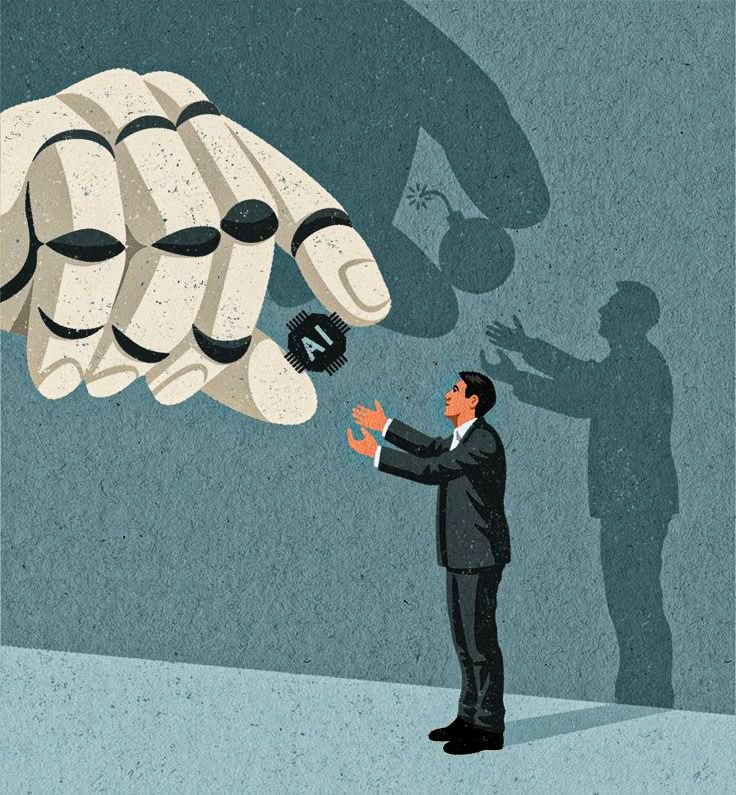
 and machine learning (ML) are transforming modern society at an extraordinary pace. From healthcare and finance to education, transportation, and entertainment,)
Artificial intelligence (AI) and machine learning (ML) are transforming modern society at an extraordinary pace. From healthcare and finance to education, transportation, and entertainment, intelligent systems are increasingly shaping how people live and work. AI technologies can analyze massive amounts of data, automate complex tasks, and make decisions faster than humans in many situations.
While these innovations offer enormous benefits, they also raise serious ethical concerns. Questions about privacy, bias, accountability, employment, and human control have become central to discussions about the future of AI. As intelligent systems become more powerful and integrated into daily life, societies must carefully consider how these technologies should be designed, regulated, and used responsibly.
The ethics of artificial intelligence is therefore not only a technological issue but also a social, political, and philosophical challenge.
Understanding Artificial Intelligence and Machine Learning
Artificial intelligence refers to computer systems designed to perform tasks that normally require human intelligence, such as decision-making, language understanding, and problem-solving.
Machine learning is a branch of AI that allows systems to learn from data and improve performance over time without being explicitly programmed for every task. These systems identify patterns in large datasets and use algorithms to make predictions or recommendations.
AI technologies are now used in facial recognition, recommendation systems, virtual assistants, autonomous vehicles, medical diagnosis, and financial analysis. Their growing influence makes ethical considerations increasingly important.
Bias and Discrimination in AI
How Bias Develops
One of the most significant ethical concerns in AI is algorithmic bias. Machine learning systems learn from existing data, and if that data contains social or historical biases, the AI may reproduce or even strengthen discrimination.
For example, biased hiring algorithms may unfairly favor certain groups over others, while facial recognition systems may perform less accurately for some ethnicities or genders.
Social Consequences
Biased AI systems can reinforce inequality in areas such as employment, healthcare, policing, education, and financial services. Because algorithms are often viewed as objective, unfair decisions may go unnoticed or remain difficult to challenge.
Reducing Bias
Developers and organizations can reduce bias by using diverse datasets, conducting fairness testing, and increasing transparency in algorithm design. Ethical oversight and inclusive development teams are also essential.
Privacy and Data Collection
Massive Data Dependence
AI systems rely heavily on large amounts of personal data. Social media activity, online searches, location tracking, and consumer behavior are frequently used to train machine learning models.
This dependence on data raises concerns about surveillance, consent, and the misuse of personal information.
Risks to Individual Privacy
Companies and governments may collect sensitive data without users fully understanding how it will be used. Facial recognition and predictive analytics technologies can further expand digital surveillance.
Unauthorized data sharing and cyberattacks also increase risks related to identity theft and personal security.
Ethical Data Practices
Protecting privacy requires stronger data protection laws, transparent policies, and informed user consent. Organizations must balance innovation with respect for individual rights and confidentiality.
Accountability and Responsibility
Who Is Responsible for AI Decisions?
As AI systems become more autonomous, determining responsibility becomes increasingly complicated. If a self-driving car causes an accident or an AI system makes a harmful medical recommendation, questions arise about who should be held accountable.
Responsibility may involve developers, companies, governments, or users depending on the situation.
Need for Transparency
Many AI models operate as “black boxes,” meaning their decision-making processes are difficult to understand even for experts. Lack of transparency can reduce trust and make it harder to identify errors or discrimination.
Explainable AI systems aim to provide clearer reasoning behind algorithmic decisions, improving accountability and public confidence.
Employment and Economic Impact
Automation and Job Displacement
AI and automation technologies are changing labor markets worldwide. Repetitive and routine tasks in manufacturing, customer service, transportation, and administration are increasingly being automated.
This can improve efficiency but may also lead to unemployment or economic inequality if workers are not supported through transitions.
Creation of New Opportunities
At the same time, AI creates new industries and job opportunities in areas such as data science, cybersecurity, robotics, and software development.
The challenge for societies is ensuring workers receive education and training needed to adapt to changing economic conditions.
AI in Warfare and Security
Autonomous Weapons
The development of AI-powered military technologies has raised ethical concerns about autonomous weapons systems capable of selecting and attacking targets without direct human control.
Critics argue that allowing machines to make life-and-death decisions could reduce accountability and increase the risk of conflict escalation.
Surveillance Technologies
Governments and security agencies increasingly use AI for monitoring, facial recognition, and predictive policing. While these tools may improve security, they can also threaten civil liberties and human rights if abused.
Balancing national security with privacy and freedom remains a major ethical challenge.
The Role of Governments and Regulation
Governments play a crucial role in establishing ethical guidelines and legal frameworks for AI development. Regulations may address issues such as privacy protection, transparency, safety standards, and anti-discrimination measures.
International cooperation is also important because AI technologies operate globally and influence multiple industries and societies.
Some experts advocate for global ethical standards to ensure AI development aligns with human rights and democratic values.
Human Control and Ethical Decision-Making
A central ethical question is how much control humans should maintain over intelligent systems. Many researchers argue that AI should assist rather than replace human judgment, especially in sensitive areas such as healthcare, law enforcement, and criminal justice.
Human oversight remains essential for ensuring fairness, empathy, and moral responsibility in decision-making processes.
Ethical AI development should prioritize human well-being, dignity, and social benefit rather than focusing solely on profit or efficiency.
The Future of Ethical AI
The future of AI ethics will depend on cooperation between governments, technology companies, researchers, and civil society. As AI systems become more advanced, ethical concerns will likely grow more complex.
Emerging technologies such as generative AI, artificial general intelligence, and advanced robotics may create new social and philosophical challenges.
Responsible innovation, public awareness, and inclusive policymaking will be essential for ensuring that AI technologies benefit humanity while minimizing harm.
Conclusion
Artificial intelligence and machine learning have the potential to improve healthcare, education, communication, and economic productivity on a global scale. However, these technologies also present serious ethical challenges involving bias, privacy, accountability, employment, and human rights.
Addressing these issues requires careful regulation, ethical design practices, transparency, and ongoing public discussion. The future of AI should not be determined solely by technological capability but also by human values and social responsibility.
As societies continue integrating AI into everyday life, ethical decision-making will become increasingly important for building a fair, secure, and inclusive digital future.
FAQs
What is artificial intelligence?
Artificial intelligence is technology that enables machines or computer systems to perform tasks that normally require human intelligence.
What is machine learning?
Machine learning is a branch of AI where systems learn patterns from data and improve performance without explicit programming for every task.
Why is AI ethics important?
AI ethics is important because intelligent systems can affect privacy, fairness, employment, security, and human rights.
What is algorithmic bias?
Algorithmic bias occurs when AI systems produce unfair or discriminatory outcomes due to biased training data or design.
How does AI threaten privacy?
AI relies on large amounts of personal data, which can increase surveillance, data misuse, and unauthorized information sharing.
Can AI replace human jobs?
AI can automate many routine tasks, potentially replacing some jobs while also creating new opportunities in technology-related fields.
What are autonomous weapons?
Autonomous weapons are AI-powered military systems capable of operating and making targeting decisions with limited human intervention.
Why is transparency important in AI?
Transparency helps users understand how AI systems make decisions, improving accountability and trust.
Can AI make ethical decisions?
AI can follow programmed ethical guidelines, but human oversight is still necessary because machines lack human judgment and moral understanding.
What is the future of AI ethics?
The future will likely involve stronger regulations, global ethical standards, and ongoing debates about balancing innovation with human rights and safety.